nedjelja, 14. lipnja 2020.

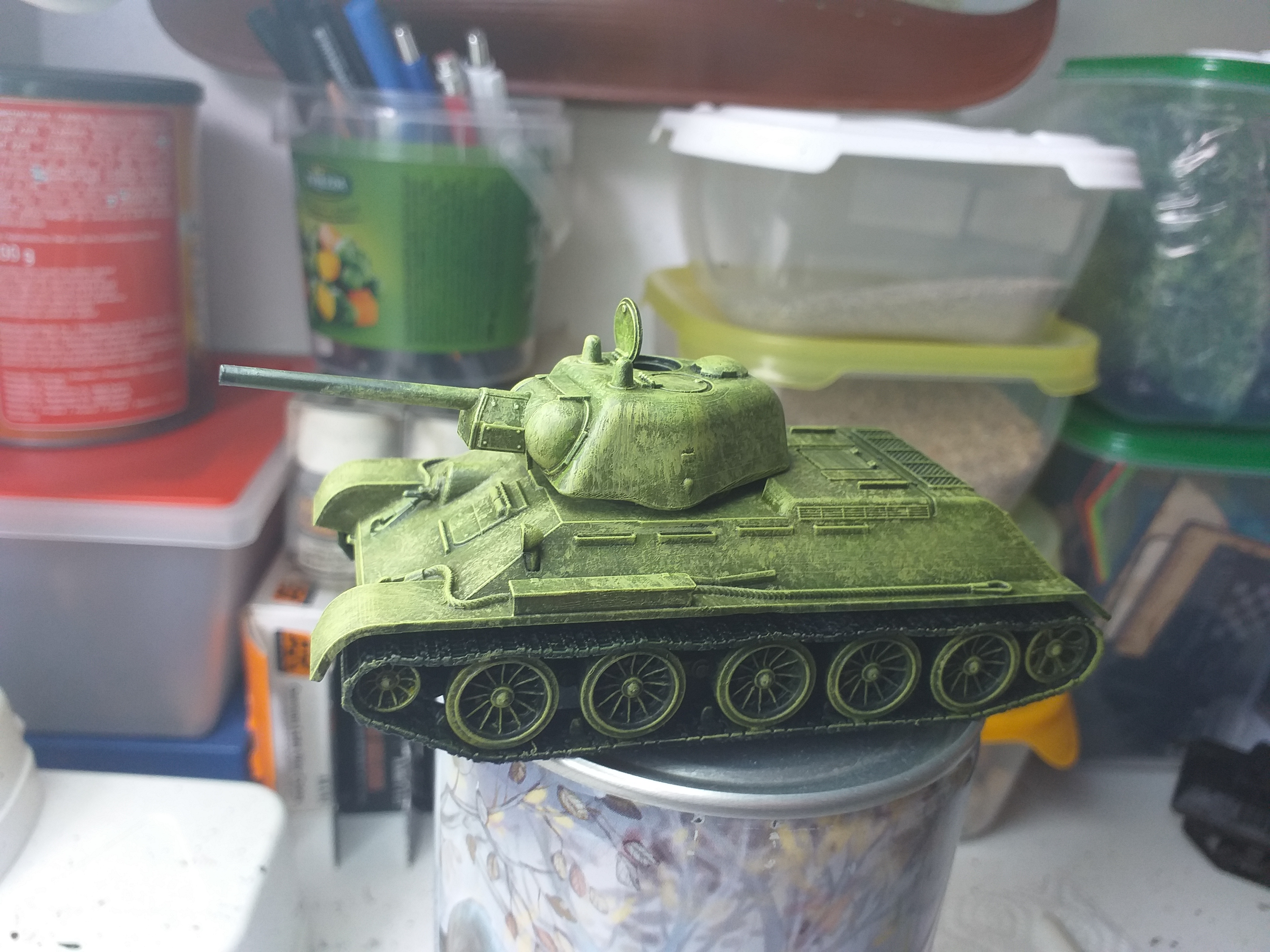
T-34/76 (1/56) - Konstantin Mihajlovič Samohin


Konstantin Mihajlovič Samohin i njegov T-34/76.

 
Obojao Tom
----------------------------------------------------------------------------------------------
Umjesto standardne copy/paste priče o ovom tenku (to će biti drugom prilikom), zamolio sam Duleta da nam nađe priču o nekom tenkistu heroju.

Konstantin Mihajlovič Samohin

Za ovog tenkistu rat je počeo od prvog dana nemačkog napada na SSSR. U prvo vreme Konstantin Samohin je ratovao na tenku BT -7, međutim, ubrzo je zadužio novi tenk T-34.

13. studenog 1941, u borbi za sela Skirmanovo i Kozlovo, njegova posada T-34/76 uništila je 6 tenkova, 3 protutenkovska topa, 2 minobacača, 4 mitraljeska gnijezda, 10 bunkera i do čete neprijateljskih vojnika.

Posada K. M. Samohina bila je u bici 20 sati. Pet puta se njegova posada vraćala na svoj početni položaj, popunjavala municijom i ponovo se vraćala u bitku. U ovoj je bici Samohin je zadobio teški potres mozga. Zapovjedništvo 1. gardijske tenkovske brigade predložilo ga je za u zvanje heroja Sovjetskog Saveza, ali je tom prilikom nagrađen Ordenom Lenjina (27. prosinca 1941.).

Početkom prosinca 1941., obuzdavajući njemačku ofenzivu, 1. gardijska tenkovska brigada i 8. gardijska streljačka divizija prešli su na novu liniju obrane Krjukovo - Kamenka - Goretovka, s koje je 6. prosinca počeo kontranapad u blizini Moskve. Lijevo od njih je bila 18. streljačka divizija, formirana od milicije grada Moskve. Nijemci su pokrenuli snažnu ofenzivu, posebno na mjestu 18. streljačke divizije, pokušavajući se probiti iza stražnjih dijelova 8. gardijske streljačke i 1. gardijske tenkovske brigade.

Nakon što su bacili veliki broj tenkova i pješaštva u napad protiv 18. pješačke divizije, Nemci su zauzeli naselja Šemetkovo i Nadovražino. Pružajući podršku napadima postrojbi 18. pješačke divizije, skupina K. M. Samohina iz 7 T-34 naglo je upala na neprijateljski položaj u Nadovražinu. Posada K. M. Samohina uništila je 5 tenkova, 6 samohodnih topova, 50 motocikla i do 100 vojnika i časnika. Njemački tenkovi koji su dolazili iz Turova i Dedova namjeravali su protunapad, ali se K. M. Samohin izvukao iz obruča, a njemački su tenkisti, izgubivši orijentaciju, dugo pucali jedan na drugog:

Njegov saborac je u memoarima napisao: "Ovdje mi je moj Samohin pokazao vojni trik koji je bio umjetnički manevar! Nijemci su pobijedili su jedni druge”. Samohinova grupa se vratila na početni položaj bez gubitaka.

U dobi od 27 godina, Konstantin Mihajlovič Samokhin poginuo je u bici u blizini sela Aržhaniki, u Smolenskoj oblasti 22. veljače 1942.

Heroj Sovjetskog Saveza A. Raftopulo opisao je njegovu posljednju bitku: “Naša gardijska brigada borila se na zemlji Karmanovskog okruga Smolenske oblasti. Prvo selo za koje smo se borili bilo je selo Petuški. Nacisti su se žestoko odupirali, a već je na ovom koraku naš omiljeni Kostja Samohin umalo poginuo - granata velikog kalibra pogodila je njegov tenk i on je samo čudom preživio. Bio je kontuzovan i nije mogao da čuje ali je odbio je otići u sanitarnu jedinicu.

Borbe za selo su se nastavile pa je selo je tri puta prešlo iz ruke u ruku. Ipak, nakon nekoliko dana smo odbacili naciste i krenuli dalje u napad . Bataljoni kapetana Burde i starijeg poručnika Samohina bili su nedaleko od sela Vetrovo i Aržaniki.

22. veljače Samohina je pozvao general Katukov. Čestitao mu je što je dobio čin kapetana... Noću je bataljon stigao do početne pozicije za napad na selo Aržaniki. Bila je to vrlo žestoka bitka. Selo je oslobođeno, ali mladi zapovjednik bataljona Samohin, koji je tek postao kapetan, poginuo je. U blizini sela pogođen je njegov tenk. Tri teške granate probile su mu oklop, tenk se zapalio. Svi su članovi posade poginuli i spaljeni u tenku. Teško ranjeni Kostja Samohin je nekako iskočio iz tenka ali je ubrzo umro na bojnom polju.

U samo četiri i pol mjeseca borbe posada K. M. Samohina uništila je više od 30 tenkova i samohodnih topova. Prema nekim procjenama, za više od 30 bitaka njegov osobni račun bio je 69 tenkova, 10 samohodnih, 31 protutenkovskih i 30 artiljerijskih topova, 12 tegljača, 50 automobila i oklopnih vozila, kao i do 600 neprijateljskih vojnika i časnika.

Sahranjen je u zajedničkoj grobnici br. 4 u centru Karmanova.


Tekst pripremio Dule

petak, 12. lipnja 2020.

PzIII (PSC) 1:100


Da ne pišem previše, radi se o PSC "maketama" u mjerilu 1:100. Pokušao sam složiti što više različitih modela, kamuflaža negdje viđena... namjerno su vidljivi tragovi "kista" za bojanje jer je tako i na fotografiji po kojoj sam bojao.
Prajmer crni, boje razne... od žutih do smeđih tonova, zatim kontrasti, pa dry brush...

Nekoliko verzija istog tenka.
---------------------------------------------------------


------------------------------


Tom (2020-06)

četvrtak, 11. lipnja 2020.

FoW BattleReport, LW, 100 pts... (Bitka za Mamuticu)


IVAN
Hero Rifle Battalion - 33 PTS
- Hero Rifle Battalion HQ (2x SMG) - 2pts
- Hero Rifle Company (10x Rifle/MG, 1x Komissar, 2x AT Rifle) - 11 pts
- Hero Rifle Company (7x Rifle/MG, 1x Komissar, 2x AT Rifle, 2x HMG) - 10 pts
- 82mm Mortar Company (6x 82mm Mortar) - 4 pts
- 120mm Mortar Company (6x 120mm Mortar) - 6 pts
------------------------------------------------------
SUPPORT - 66 PTS
- Heavy Tank-killer Company (4x 57mm AT Gun) - 12 pts
- BA-10 Armoured Car Platoon (3x BA-10 45mm) - 2 pts
- KV-1 Guards Heavy Tank Company (4x KV-1 76mm) - 16 pts
- T-34 Tank Company (3x T-34/76, 3x T-34/85) - 24 pts
------------------------------------------------------
Fortress Europe Soviet Command Cards - 1 PTS
  Lucky Card - 1 pts
----------Total Points: 100


EDO
Veteran Armoured Rifle Company - 40 PTS
- Veteran Armoured Rifle Company HQ (2x SMG, 1x M3 half-track 0.50 cal) - 3pts
- Veteran Armoured Rifle Platoon (4x Rifle, 4x Bazooka, 2x LMG, 1x 60mm Mortar, 2x M3 half-track 0.30 cal, 2x M3 half-track 0.50 cal)- 15 pts
- Veteran Armoured 57mm Anti-tank Platoon (3x 57mm AT Gun) - 4 pts
- Veteran Armoured M4 81mm Mortar Platoon (3x 81mm Mortar) - 3 pts
------------------------------------------------------
SUPPORT - 45 PTS
- M12 155mm Artillery Battery (4x M15 155mm) - 12 pts
- P-47 Thunderbolt Fighter Flight (2x P47) - 9 pts
- Veteran M4 Sherman (76mm) Tank Platoon (4x M4 sherman) - 22 pts
- Universal Carrier Patrol (British Allied Unit)(3x UC) - 2 pts
------------------------------------------------------
D-Day American Command Cards - 15 PTS
  Command Card FTP Platoon 7 (2 selected)
  Add one M1 Bazooka team (per card) for +1 point. (1 selected)
----------Total Points: 100

------------------------------------------------------------------------------------


Deployment:
Prilikom postavljanja morao sam donijeti odluku na koji ću objektiv krenuti. kako je Ivan postavio svoje AT topove na brdo u sam kut table, a druge je imao u zasjedi odlučio sam se da idem na objektiv koji sam postavio izvan njegove deployment zone. Na taj način odmah sam iskljucio vod njegovih AT topova koji su mi jedna od većih prijetnji. Iskoristio sam sperhead movement svojih recon timova i prebacio gotovo cijelu vojsku prema objektivu. AR sam ostavio u vozilima kako bi što dalje mogao stići u prvom potezu. Jedino je artiljerija ostala stacionarna da radi malo štete.

1. potez:
Jurnuo sam prema objektivima sa AR vozilima i Shermanima, da bi se tamo što prije ukopao. Jedan vod FTP je krenuo aktivno prema Ivanovim položajima kako bi pokušao spriječiti/odmaknuti ambush AT topova što su na kraju i uspjeli, a drugi cilj im je bio mogući napad na mortare kako me nebi u miru mogli iskopavati sa svojim reroll to hitom.
U shooting fazi sam uspio artiljerijom pogoditi sa Time on target  pješadiju, ubiti par baza, ali i pinati ih, što ga je kasnije usporilo u napredovanju njegove pješadije.


------------------------------------------------------------------------------------

2. Potez:

Nastavljam kretanje prema objektivu, izbacujem AR sa strane s koje dolaze Ivanove rezerve kako bi spriječio eventualni brzi napredak tenkova. Radim pritisak sa FTP prema Ivanovim mortarima i potencijalnom mjestu izbacivanja zasjede. Usput pucam prema njegovom drugom vodu pješadije i radim neznatnu štetu. Malim mortarima iz vozila isto pucam po tom vodu pješadije kako bi ga natjerao da se makne sa ukopanih pozicija. Sa velikom artiljerijom bježim od dometa AT topova tako da oni ne pucaju. Shermani idu u presretanje BA-10 te ih onesposobljuju potpomognuti vatrom iz 57mm AT topova i .50 mitraljezima sa vozila.


U drugom potezu Ivanu dolaze oba voda tenkova iz rezervi, 10 komada i tad shvaćam kakvu sam glupost napravio. Ostavio sam mu sve tenkove na vjetrometini da me gađa u leđa. Na svu sreću Ivan ne uspijeva napraviti nikakvu štetu na njima zbog svojeg lošeg rolla kockica. Napokon izbacuje AT topove iz zasjede, ali mora ih stavljati u šumu jer se moja pješadija dosta pomaknula prema njegovim položajima.
Nastavlja napredovanje pješadijom u šumu. Sa teškim tenkovima ubija 2 bazuke mitraljezima i još jednu u assaultu. Tu se pokazala i moja druga velika greška gdje sam ostavio bazuke prve na udaru tenkova, a običnu pješadiju u pozadini. Drugi AR vod je ostao još u vozilima tako da njegove bazuke nisu pomagale u Defensive Fire-u. Kako nisam imao neke šanse u protunapadu povukao sam se. Ostali vodovi pretrpjeli su neznatnu štetu u Ivanovoj vatri (par baza pješadije i jedan 57mm top).

------------------------------------------------------------------------------------

3. Potez:

Konačno dolaze avioni! U jednom potezu naprave ono za što ih držim u listi. Ubiju 2 tenka i 1 bailaju. Njima se priključuju Shermani koji nažalost ubijaju još sam jednog T-34, a drugi se spasi sa double bailom. Kamioničići sa svojim mitraljezima teroriziraju pješadiju u šumi, koja ostaje na par baza i koju dovršava pješadija u napadu. Drugi dio pješadije čiste Ivanove male mortare u shootingu i napadu te smanjuje daljnju prijetnju. Artiljerija  nažalost ne uspijevaju pronaći svoju metu da malo oslabi Ivanove AT topove.


Ivan uspijeva vratiti posadu u svoje tenkove, s kojima mi ubija 2 Shermana. Artiljerijom mi ubija nekoliko baza pješadije i što je najvažnije cijeli HQ. Naivno sam ih izvadio bez neke potrebe na polje, bacio 1 i 1 za njihov save, te 2 da prebacim komandira. I tako sam ostao obezglavljen što bi vjerojatno imalo utjecaja da smo nastvili partiju i nakon treće poteza. Pošto je bio kraj Ivan je krenuo sa svojim teškim tenkovima u napad, uspio proći DF, ali je na kraju ostao bailan od bazuke u protunapadu. Tu smo završili partiju.

Završne borbe oko objektiva

Da je bilo vremena ključan bi bio 4. potez u kojem bi ili ja njemu uspio ubiti par tenkova sa Shermanima ili bi on meni ubio njih i to bi vjerojatno odredilo pobjednika, ali što bi bilo kad bi bilo ostavimo za priče uz pivu. Razlog zašto nismo završili su uprave takve priče uz pivu, te što nam je posebno drago, dolazak i družnje sa nadam se novim članom naše male Fow zajednice, Markom.

Bilo je ovo odlično druženje u ponovno bacanje kockica nakon 3-4 mjeseca.
   
Napisao Edo
Posložio Tom (2020-06)

nedjelja, 7. lipnja 2020.

Saxon Leaders - Battle of Stamford Bridge (Warlord Games)


Morcar of Northumbria

Morcar (or Morkere) (Old English: Mōrcǣr) (died after 1087) was the son of Ælfgār (earl of Mercia) and brother of Ēadwine. He was the earl of Northumbria from 1065 to 1066, when he was replaced by William the Conqueror with Copsi.

Morcar and his brother Ēadwine, now Earl of Mercia, assisted the Northumbrian rebels to expel Tostig Godwinson. In October 1065 the Northumbrians chose Morcar as earl at York. He at once satisfied the people of the Bernicia by making over the government of the country beyond the River Tyne to Osulf of Bamburgh the eldest son of Eadwulf III of Bamburgh, the Bernician earl, whom Siward had slain in 1041. Marching southwards with the rebels, Morcar gathered into his forces the men of Nottingham, Derby, and Lincoln, members of the old Danish confederacy of towns, and met Ēadwine, who was at the head of a considerable force at Northampton. There the brothers and their rebel army considered proposals for peace offered to them by Earl Harold Godwinson. Negotiations continued at Oxford, where, the Northumbrians insisting on the recognition of Morcar, Harold yielded on the 28th, and Morcar's election was legalised.

On the death of Edward the Confessor, Morcar professedly supported Harold, but the people of his earldom were dissatisfied. Harold visited York, the seat of Morcar's government, in the spring of 1066, and overcame their disaffection by peaceful means. In the summer, Morcar joined his brother Edwin in repulsing Tostig, who was ravaging the Mercian coast. When, however, Tostig and his ally Harald Hardrada invaded Northumbria in September, Morcar evidently was not ready to meet them; and it was not until York was threatened that, having then been joined by Edwin, he went out against them with a large army. The two earls were defeated at Fulford Gate, near York, in a fierce battle, in which, according to a Norse authority, Morcar seems to have been prominent.

York was surrendered, and Harold Godwinson had to march in haste to save the north by the Battle of Stamford Bridge. Ungrateful for this deliverance, Morcar and his brother held back the forces of the north from joining Harold, in the defence of the kingdom against the Normans. After the battle of Hastings, Morcar and his brother arrived at London, sent their sister Ealdgyth, Harold's widow, to Chester, and urged the citizens to raise one or other of them to the throne.

They concurred in the election of Edgar the Ætheling, but disappointed of their hope left the city with their forces and returned to the north, believing that the Conqueror would not advance so far. Before long, however, they met William of Normandy either at Berkhamstead, or more probably at Barking, after his coronation. William accepted their submission, received from them gifts and hostages, and they were reinstated. The Conqueror carried Morcar and his brother with him into Normandy in 1067, and after his return kept them at his court.

In 1068, they withdrew from the court, reached their earldoms, and rebelled against William. They were supported by a large number both of English and Welsh; the clergy, the monks, and the poor were strongly on their side, and messages were sent to every part of the kingdom to stir up resistance. Morcar's activity may perhaps be inferred from the prominent part taken in the movement by York. It seems probable, however, that Edgar was nominally the head of the rebellion, and that he was specially upheld by the Bernician district under Gospatric. Morcar and his brother were not inclined to risk too much; they advanced with their men to Warwick, and there made submission to the Conqueror, were pardoned, and again kept at court, the king treating them with an appearance of favour. On their defection, the rebellion came to nothing. In 1071, some mischief was made between them and the king, and William, it is said, was about to send them to prison, but they escaped secretly from the court.

After wandering about for a while, keeping to wild country, they separated, and Morcar joined the insurgents in the Isle of Ely, and remained with them until the surrender of the island. Morcar, it is said, surrendered himself on the assurance that the king would pardon him and receive him as a loyal friend. William, however, committed him to the custody of Roger de Beaumont, who kept him closely imprisoned in Normandy.

When the king was on his deathbed in 1087, he ordered that Morcar should be released, in common with others whom he had kept in prison in England and Normandy, on condition that they took an oath not to disturb the peace in either land. He was not long out of prison, for William Rufus took him to England, and on arriving at Winchester put him in prison there. Nothing further is known about him, and it is therefore probable that he died in prison.

https://en.wikipedia.org/wiki/Morcar

----------------------------------------------------------------------------------------------
Edwin of Mercia
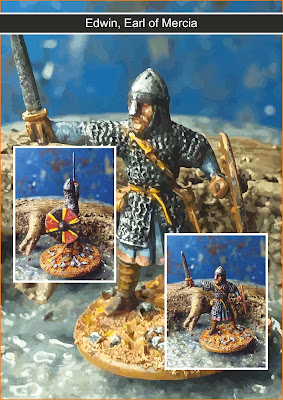
Edwin, Earl of Mercia

Edwin (Old English: Ēadwine) (died 1071) was the elder brother of Morcar, Earl of Northumbria, son of Ælfgār, Earl of Mercia and grandson of Leofric, Earl of Mercia. He succeeded to his father's title and responsibilities on Ælfgār's death in 1062. He appears as Earl Edwin (Eduin comes) in the Domesday Book.

His younger brother, Morcar was elected Earl of Northumbria when Tostig Godwinson was ejected by the Northumbrians (October 3, 1065). Tostig had been accused of robbing churches, depriving men of their lands and lives, and acting against the law.

In 1066 Tostig raided in Mercia but was repulsed by Edwin and Morcar and fled to Scotland. Later in the year he returned, accompanied by King Harald Hardrada of Norway at the head of a huge Norwegian army, which defeated Edwin and Morcar at the Battle of Fulford near York (September 20). Harald and Tostig were in turn defeated and slain by Harold Godwinson's army, five days later at the Battle of Stamford Bridge (September 25). After Harold's death at the Battle of Hastings, where Edwin and Morcar were absent, they were the principal supporters of a new regime under Edgar the Ætheling, though they had wished the public to elect one of them king, but failed to take effective steps against the invading Normans and soon submitted to Duke William.

In 1068, Edwin and Morcar attempted to raise a rebellion in Mercia but swiftly submitted when William moved against them. Edwin died in 1071; while making his way to Scotland he was betrayed by his own retinue to the Normans and killed.

Edwin's sister, Ealdgyth, had been married to Harold Godwinson until the latter's death at Hastings on 14 October 1066.

Edwin's lands centred at Gilling West in his brother's Northumbrian earldom, were given to Alain Le Roux (also known as Alan Rufus) in 1071 or perhaps earlier, and the district was renamed Richmondshire, or the Honour of Richmond.

https://en.wikipedia.org/wiki/Edwin,_Earl_of_Mercia

----------------------------------------------------------------------------------------------

Tostig
Tostig Godwinson

Tostig Godwinson (c. 1026 – 25 September 1066) was an Anglo-Saxon Earl of Northumbria and brother of King Harold Godwinson. After being exiled by his brother, Tostig supported the Norwegian king Harald Hardrada's invasion of England, and was killed at the Battle of Stamford Bridge in 1066.

Tostig was the third son of the Anglo-Saxon nobleman Godwin, Earl of Wessex and Gytha Thorkelsdóttir, the daughter of Danish chieftain Thorgil Sprakling. In 1051, he married Judith of Flanders the only child of Baldwin IV, Count of Flanders by his second wife, Eleanor of Normandy. The Domesday Book recorded twenty-six vills or townships as being held by Earl Tostig forming the Manor of Hougun which now forms part of the county of Cumbria in north-west England.

In the 19th century the antiquarian Edward Augustus Freeman posited a hypothesis claiming that Edward the Confessor was pursuing a policy of "Normanization" of England and by doing so was reducing the influence of the Godwins. In 1051 Earl Godwin's opposition to Edward's policies had brought England to the brink of civil war. Because of their opposition to the king the Godwins eventually were banished in 1051. The Freeman explanation, of why they were banished, has many critics, as it does not fully explain the relationship between the Godwins and the king.

The banished Godwin, Gytha and Tostig, together with Sweyn and Gyrth, sought refuge with the Count of Flanders. They returned to England the following year with armed forces, gaining support and compelling Edward to restore his earldom. Three years later in 1055, Tostig became the Earl of Northumbria upon the death of Earl Siward.

Tostig appears to have governed in Northumbria with some difficulty. He was never popular with the Northumbrian ruling class, a mix of Danish invaders and Anglo Saxon survivors of the last Norse invasion. Tostig was said to have been heavy-handed with those who resisted his rule, including the murder of several members of leading Northumbrian families. In late 1063 or early 1064, Tostig had Gamal, son of Orm and Ulf, son of Dolfin, assassinated when they visited him under safe conduct. Also, the Vita Edwardi, otherwise sympathetic to Tostig, states that he had 'repressed [the Northumbrians] with the heavy yoke of his rule'.

He was also frequently absent at the court of King Edward in the south, and possibly showed a lack of leadership against the raiding Scots. Their king was a personal friend of Tostig, and Tostig's unpopularity made it difficult to raise local levies to combat them. He resorted to using a strong force of Danish mercenaries (housecarles) as his main force, an expensive and resented policy (the housecarls' leaders were later slaughtered by rebels). Local biases probably also played a part. Tostig was from the south of England, a distinctly different culture from the north, which had not had a southern earl in several lifetimes. In 1063, still immersed in the confused local politics of Northumbria, his popularity apparently plummeted. Many of the inhabitants of Northumbria were Danes, who had enjoyed lesser taxation than in other parts of England. Yet the wars in Wales, of which Tostig's constituents were principal beneficiaries, needed to be paid for. Tostig had been a major commander in these wars attacking in the north while his brother Harold Godwinson marched up from the south.

On 3 October 1065, the thegns of York and the rest of Yorkshire descended on York and occupied the city. They killed Tostig's officials and supporters, then declared Tostig outlawed for his unlawful actions and sent for Morcar, younger brother of Edwin, Earl of Mercia. The northern rebels marched south to press their case with King Edward. They were joined at Northampton by Earl Edwin and his forces. There, they were met by Earl Harold, who had been sent by King Edward to negotiate with them and thus did not bring his forces. After Harold, by then the king's right-hand man, had spoken with the rebels at Northampton, he likely realized that Tostig would not be able to retain Northumbria. When he returned to Oxford, where the royal council was to meet on 28 October, he had probably already made up his mind.

Harold Godwinson persuaded King Edward the Confessor to agree to the demands of the rebels. Tostig was outlawed a short time later, possibly early in November, because he refused to accept his deposition as commanded by Edward. This led to the fatal confrontation and enmity between the two Godwinsons.[citation needed] At a meeting of the king and his council, Tostig publicly accused Harold of fomenting the rebellion. Harold was keen to unify England in the face of the grave threat from William of Normandy, who had openly declared his intention to take the English throne. It was likely that Harold had exiled his brother to ensure peace and loyalty in the north. Tostig, however, remained unconvinced and plotted vengeance.

Tostig took ship with his family and some loyal thegns and took refuge with his brother-in-law, Baldwin V, Count of Flanders. He even attempted to form an alliance with William. Baldwin provided him with a fleet and he landed in the Isle of Wight in May 1066, where he collected money and provisions. He raided the coast as far as Sandwich but was forced to retreat when King Harold called out land and naval forces. He moved north and after an unsuccessful attempt to get his brother Gyrth to join him, he raided Norfolk and Lincolnshire. The Earls Edwin and Morcar defeated him decisively. Deserted by his men, he fled to his sworn brother, King Malcolm III of Scotland. Tostig spent the summer of 1066 in Scotland.

He made contact with King Harald III Hardrada of Norway and persuaded him to invade England. One of the sagas claims that he sailed for Norway, and greatly impressed the Norwegian king and his court, managing to sway a decidedly unenthusiastic Harald, who had just concluded a long and inconclusive war with Denmark, into raising a levy to take the throne of England. With Hardrada's aid, Tostig sailed up the Humber and defeated Morcar and Edwin at Gate Fulford.

Hardrada's army and Tostig invaded York, taking hostages after a peaceful surrender, and acquiring provisions. King Harold Godwinson raced northward with an English army from London and, on 25 September 1066, surprised his brother Tostig at Stamford Bridge. Hardrada, Tostig and many of their men were killed. The Norwegians and the Flemish mercenaries hired by Tostig were largely without armour and carried only personal weapons. The day was very hot and no resistance was expected. The remainder of the 11,000-man force remained guarding the Norse ships, beached miles away at Riccall.

After his death at Stamford Bridge, it is believed that Tostig's body was taken to France and then buried at York Minster. Tostig's two sons took refuge in Norway, while his wife Judith married Duke Welf of Bavaria. The victorious Harold, at the head of troops, still exhausted by their previous fight with Tostig and Hardrada, would go to confront and suffer defeat at the hands of the Normans at the Battle of Hastings nineteen days later.

https://en.wikipedia.org/wiki/Tostig_Godwinson

Tom (2020-06)

Saxon Kings - 9th Century (Warlord Games)


Aella
Ælla of Northumbria

Ælla (or Ælle or Aelle) (fl. 866; died 21 March 867) was King of Northumbria, a kingdom in medieval England, during the middle of the 9th century. Sources on Northumbrian history in this period are limited, and so Ælla's ancestry is not known and the dating of the beginning of his reign is questionable.

In addition to the Anglo-Saxon Chronicle, Ælla is also mentioned in Scandinavian sources, such as the Norse sagas. According to the latter, Ælla captured the semi-legendary Swedish-Danish Viking leader Ragnar Lodbrok and put him to death in a pit of snakes. The historical invasion of Northumbria in 866 occurred in retaliation for Ragnar's execution, according to Ragnarssona þáttr (The Tale of Ragnar's Sons). While Norse sources claim that Ragnar's sons tortured Ælla to death by the method of the blood eagle, Anglo-Saxon accounts maintain that he died in battle at York on 21 March 867. Concerning the Norse claim, Roberta Frank reviewed the historical evidence for the ritual in her Viking Atrocity and Skaldic Verse: The Rite of the Blood-Eagle, where she writes: "By the beginning of the nineteenth century, the various saga motifs—eagle sketch, rib division, lung surgery, and 'saline stimulant'—were combined in inventive sequences designed for maximum horror." She concludes that the authors of the sagas misunderstood alliterative kennings that alluded to leaving one's foes face down on the battlefield, their backs torn as carrion by scavenging birds. If this is to be believed, then it is easy to surmise that the mention of his death via the blood eagle, is in fact a description of his death on the battlefield, which would make both accounts of his death true...

https://en.wikipedia.org/wiki/%C3%86lla_of_Northumbria

--------------------------------------------------------------------------------

Alfred
Alfred the Great

Alfred the Great (Old English: Ælfrēd,[b] Ælfrǣd,[c] 'Elf-counsel' or 'Wise-elf'; between 847 and 849 – 26 October 899) was King of Wessex from 871 to c.  886 and King of the Anglo-Saxons from c.  886 to 899. He was the youngest son of King Æthelwulf of Wessex. His father died when he was young and three of Alfred's brothers, Æthelbald, Æthelberht and Æthelred, reigned in turn before him.

After ascending the throne, Alfred spent several years fighting Viking invasions. He won a decisive victory in the Battle of Edington in 878 and made an agreement with the Vikings, creating what was known as the Danelaw in the North of England. Alfred also oversaw the conversion of Viking leader Guthrum to Christianity. He defended his kingdom against the Viking attempt at conquest, becoming the dominant ruler in England. Details of his life are described in a work by 9th-century Welsh scholar and bishop Asser.

Alfred had a reputation as a learned and merciful man of a gracious and level-headed nature who encouraged education, proposing that primary education be conducted in Anglo-Saxon rather than Latin and improving the legal system and military structure and his people's quality of life. He was given the epithet "the Great" during and after the Reformation in the sixteenth century, and, alongside the Danish Cnut the Great, remains the only king of England to be given such a name...

https://en.wikipedia.org/wiki/Alfred_the_Great

--------------------------------------------------------------------------------

Athelstan
Æthelstan

Æthelstan or Athelstan (/ˈæθəlstæn/; Old English: Æþelstan[a] or Æðelstān;[b] Old Norse: Aðalsteinn meaning "noble stone"; c. 894 – 27 October 939) was King of the Anglo-Saxons from 924 to 927 and King of the English from 927 to 939 when he died.[c] He was the son of King Edward the Elder and his first wife, Ecgwynn. Modern historians regard him as the first King of England and one of the greatest Anglo-Saxon kings. He never married and had no children. He was succeeded by his half-brother, Edmund.

When Edward died in July 924, Æthelstan was accepted by the Mercians as king. His half-brother Ælfweard may have been recognised as king in Wessex, but died within three weeks of their father's death. Æthelstan encountered resistance in Wessex for several months, and was not crowned until September 925. In 927 he conquered the last remaining Viking kingdom, York, making him the first Anglo-Saxon ruler of the whole of England. In 934 he invaded Scotland and forced Constantine II to submit to him, but Æthelstan's rule was resented by the Scots and Vikings, and in 937 they invaded England. Æthelstan defeated them at the Battle of Brunanburh, a victory which gave him great prestige both in the British Isles and on the Continent. After his death in 939 the Vikings seized back control of York, and it was not finally reconquered until 954.

Æthelstan centralised government; he increased control over the production of charters and summoned leading figures from distant areas to his councils. These meetings were also attended by rulers from outside his territory, especially Welsh kings, who thus acknowledged his overlordship. More legal texts survive from his reign than from any other 10th-century English king. They show his concern about widespread robberies, and the threat they posed to social order. His legal reforms built on those of his grandfather, Alfred the Great. Æthelstan was one of the most pious West Saxon kings, and was known for collecting relics and founding churches. His household was the centre of English learning during his reign, and it laid the foundation for the Benedictine monastic reform later in the century. No other West Saxon king played as important a role in European politics as Æthelstan, and he arranged the marriages of several of his sisters to continental rulers...

https://en.wikipedia.org/wiki/%C3%86thelstan


Tom (2020-06)